Components
SourceLab is split over several processes that share one Python package. Only the web application and its workers are required, along with a SQL database, a filesystem shared by all of them for the git repositories, and sshd if you want SSH access.
Most features follow this path: the web application answers the request, and hands anything slow to a worker as a job, written to a table of the database.

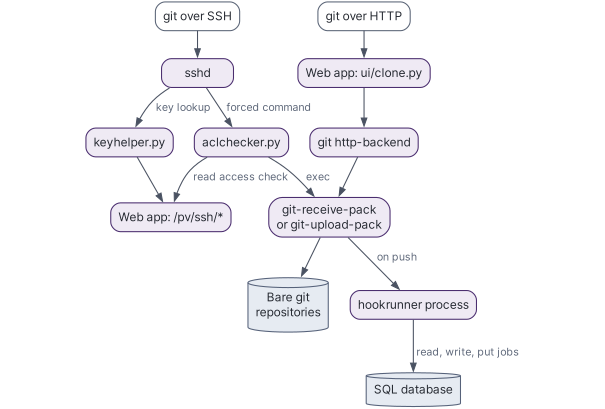
Git access takes a different route, over SSH or HTTP. Both end in the same git commands. A push runs SourceLab's hooks.
| Process | Started by | Required |
|---|---|---|
| Web application | sourcelab_web (uvicorn), or files/sourcelab.wsgi |
Yes |
Worker, the Myxo services projects, repos, pull_requests and stats |
sourcelab_worker (myxo serve) |
Yes |
| Git hooks | git, on each push | Yes |
SSH helpers (keyhelper.py, aclchecker.py) |
sshd |
For SSH access |
authorized_keys worker, the Myxo service keys |
sourcelab_authorized_keys_worker (myxo serve) |
No |
| Webhooks, commit log, JSON load | sourcelab_webhook, sourcelab_logcom, sourcelab_loadjson (myxo serve) |
See below |
Builds, the Myxo services builds, builds_blobs, builds_forge_accounts and builds_forge |
myxo serve, in the web application's process |
No |
Build runners, the Myxo service builds_runner |
myxo serve, on their own machines |
For builds |
Mirroring, the Myxo service mirror |
sourcelab_mirror (myxo serve) |
No |
| Documentation server | sourcelab_docs_web |
No |
| Email replies | sourcelab_milter |
No |
| Periodic jobs | systemd timers | No |
The systemd units are in files/, except that of the email replies, which is in packages/sourcelab-milters/.
Core application
The core application is an ASGI application, written with Litestar. It provides a web UI to the git repositories, tickets and pull requests, along with a JSON API.
Workers
Working on git repositories can take a long time, depending on the size of the repository, the hardware and the load on the system. So the web application doesn't do it itself: dedicated workers do, asynchronously, while the user waits on a /wait page.
The workers are Myxo services. The web application and the git hooks put jobs in a table of the SQL database, myxo_jobs, in the transaction of their change, and the services take them from there. Each service runs in a process of the layout /etc/sourcelab/layout.toml, alone or with others, and myxo migrate creates the tables.
Services in their own process
Some services run in a process of their own, so that a slow third party can't hold up the rest:
- Webhooks send notifications to third party services with HTTP POST requests. See Webhooks.
- Commit log updates the log table on every push, which provides the data for the calendar heatmap on each user's page. See Log Commits.
- JSON load updates the database from what was pushed to a ticket or pull request git repository. See Load JSON.
Warning
A job only runs if a process of the layout runs its service. Without one, the application still puts the jobs and reports no error: they just pile up in the database. So if you need one of these features, make sure that its service is running.
Optional services
The first two run as their own processes, outside the main application.
Documentation server
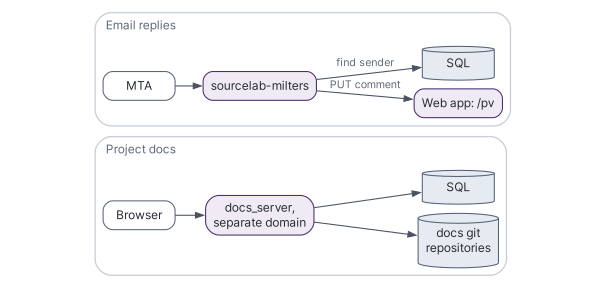
This server displays the documentation that users provide for their projects. Since displaying content provided by users is a security risk, it is separate from the main application. We strongly encourage you to run it on a completely different domain name (not just a subdomain) to reduce the cross-site forgery risks.
SourceLab runs fine without it: just don't define DOC_APP_URL in the configuration file.
Milter
The milter lets people reply to a comment on a ticket or a pull request by replying to the notification email. It integrates with an MTA such as postfix or sendmail, whose configuration you need to be able to change. See Email Replies.
Builds
The builds run the manifests of a project's repository on each push, as builds.sr.ht does, on runners: other machines, which run each job in a fresh container and take nothing but jobs from the forge. They are a plugin, the sourcelab-builds package. See Builds.
Live updates
The web application can refresh the issue and pull request pages while someone is viewing them: if someone comments on the ticket you're reading, the comment shows up without reloading the page. It publishes each change on redis, and sends it to the pages that follow it as server-sent events. This takes a redis server, but no process of its own. See Live Updates.